
Social anxiety counselling
InnerHub · 2026-08-30 · 16 min read
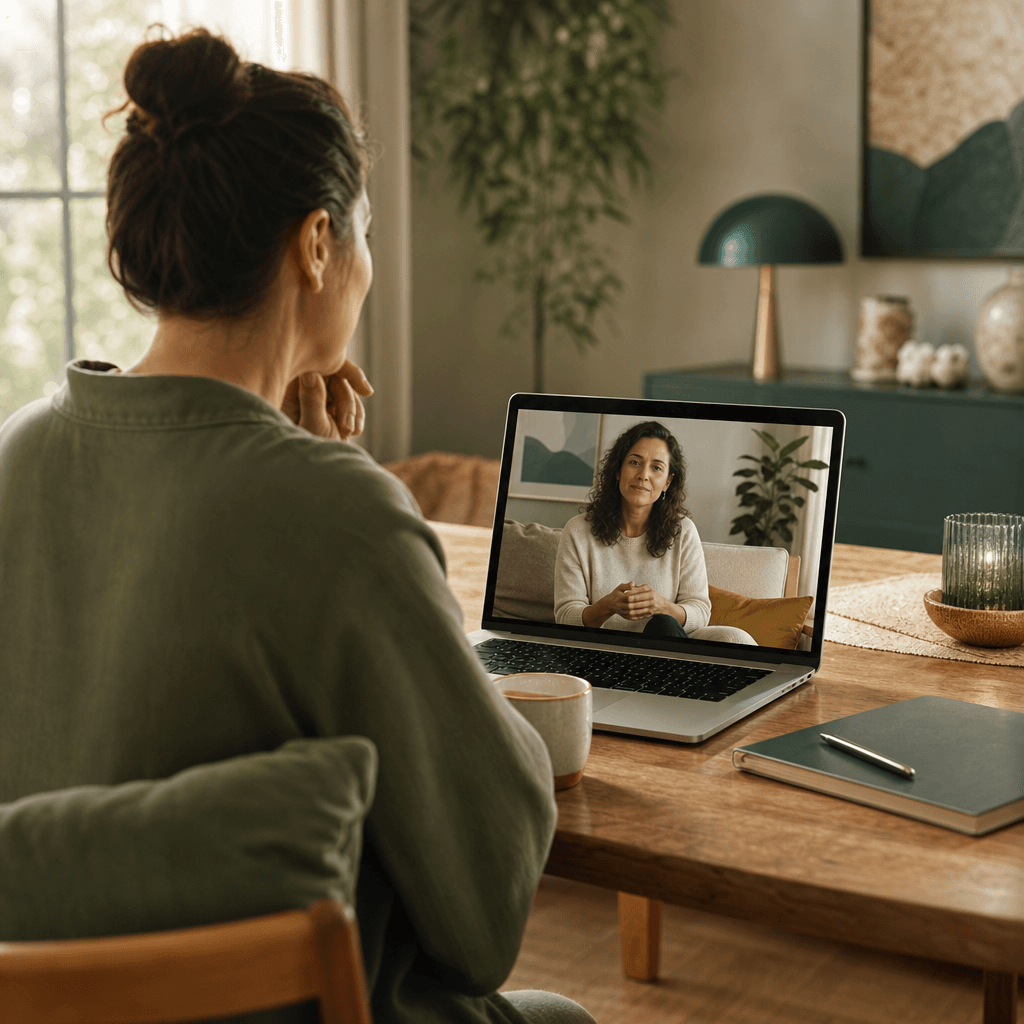
Social anxiety counselling helps you understand the thoughts, physical reactions and avoidance patterns that make social situations feel threatening. A suitable practitioner can help you test anxious predictions, reduce safety behaviours and approach feared situations gradually. Effective support should be practical, collaborative and available often enough for you to use it consistently.
Social anxiety can affect conversations, meetings, dating, study, work and ordinary errands. It is not simply being quiet. The defining problem is persistent fear of scrutiny, embarrassment or rejection, followed by avoidance or intense distress.
This guide explains how counselling works, what evidence-based support can involve, how online sessions compare, and what to check before choosing a practitioner in Australia.
Key takeaways
Social anxiety counselling works best when it addresses both anxious thinking and avoidance. The goal is not to become the loudest person in the room. It is to participate in situations that matter without fear making every decision. Progress usually depends on practice between sessions, not insight alone.
- Social anxiety involves fear of being judged, embarrassed or visibly anxious.
- Avoidance brings short-term relief but often keeps the fear going.
- Counselling may use cognitive behavioural therapy, gradual exposure, attention training and acceptance-based methods.
- Practitioner fit, relevant experience and transparent credentials matter.
- Online counselling can remove travel, waiting-room and scheduling barriers.
- Counselling is not crisis care, medical diagnosis or medication management.
Talk to someone this week
Get matched with your therapist and book a session in minutes. $59.90 flat, no referral, no subscription.
Find a therapistSocial anxiety counselling at a glance
The right approach depends on your symptoms, goals, safety and previous experience with therapy. The table below shows how common counselling components address different parts of social anxiety. A practitioner may combine several methods rather than following one rigid programme for every person.
| Counselling component | What it addresses | What it can involve |
|---|---|---|
| Assessment and goal setting | Personal triggers and functional impact | Mapping feared situations, avoidance and desired changes |
| Psychoeducation | Confusion about anxiety responses | Understanding threat reactions and the avoidance cycle |
| Cognitive work | Predictions about judgement or failure | Examining evidence and testing alternative interpretations |
| Gradual exposure | Avoidance of social situations | Planned practice with manageable, relevant situations |
| Attention training | Excessive self-monitoring | Redirecting attention towards the conversation or task |
| Behavioural experiments | Assumptions about how others will react | Testing a specific prediction in everyday life |
| Acceptance-based work | Struggling to eliminate every anxious feeling | Acting according to values while allowing discomfort to pass |
| Relapse planning | Return of old habits under stress | Identifying warning signs and maintaining useful practice |
What social anxiety looks like
Social anxiety is an ongoing fear of social or performance situations where you expect scrutiny, embarrassment or rejection. It can affect your thoughts, body and behaviour before, during and after an interaction. The impact, rather than whether you appear confident to others, is what matters.
Healthdirect describes social anxiety disorder as more than ordinary shyness. It may cause intense fear and avoidance that interferes with work, relationships or daily activities. Common situations include speaking with unfamiliar people, eating in public, attending social events and being observed while completing a task.
Common thoughts
Anxious predictions often sound convincing rather than dramatic:
- "I will have nothing useful to say."
- "They will notice that I am nervous."
- "If I pause, everyone will think I am incompetent."
- "I embarrassed myself, and they will remember it."
- "I need to rehearse every sentence before I speak."
The mind may also replay conversations afterwards. This post-event review usually focuses on perceived mistakes while ignoring neutral or positive evidence.
Physical and behavioural signs
Physical signs can include blushing, sweating, nausea, trembling, muscle tension, a racing heart or difficulty speaking. Some people experience panic-like symptoms. Others appear calm while using considerable effort to control their voice, posture or facial expression.
Behavioural signs include declining invitations, avoiding eye contact, arriving late, leaving early or staying silent in meetings. More subtle safety behaviours include over-preparing, gripping an object, checking a mobile repeatedly, drinking alcohol to cope or only attending with a trusted person.
These behaviours are understandable. They also make it harder to discover whether the feared outcome would have happened without them.
Social anxiety can coexist with depression, panic symptoms, harmful alcohol use, trauma-related difficulties or other anxiety conditions. A counsellor should recognise when broader assessment or medical support is appropriate. InnerHub practitioners do not diagnose conditions or prescribe medication.
What causes and maintains social anxiety?
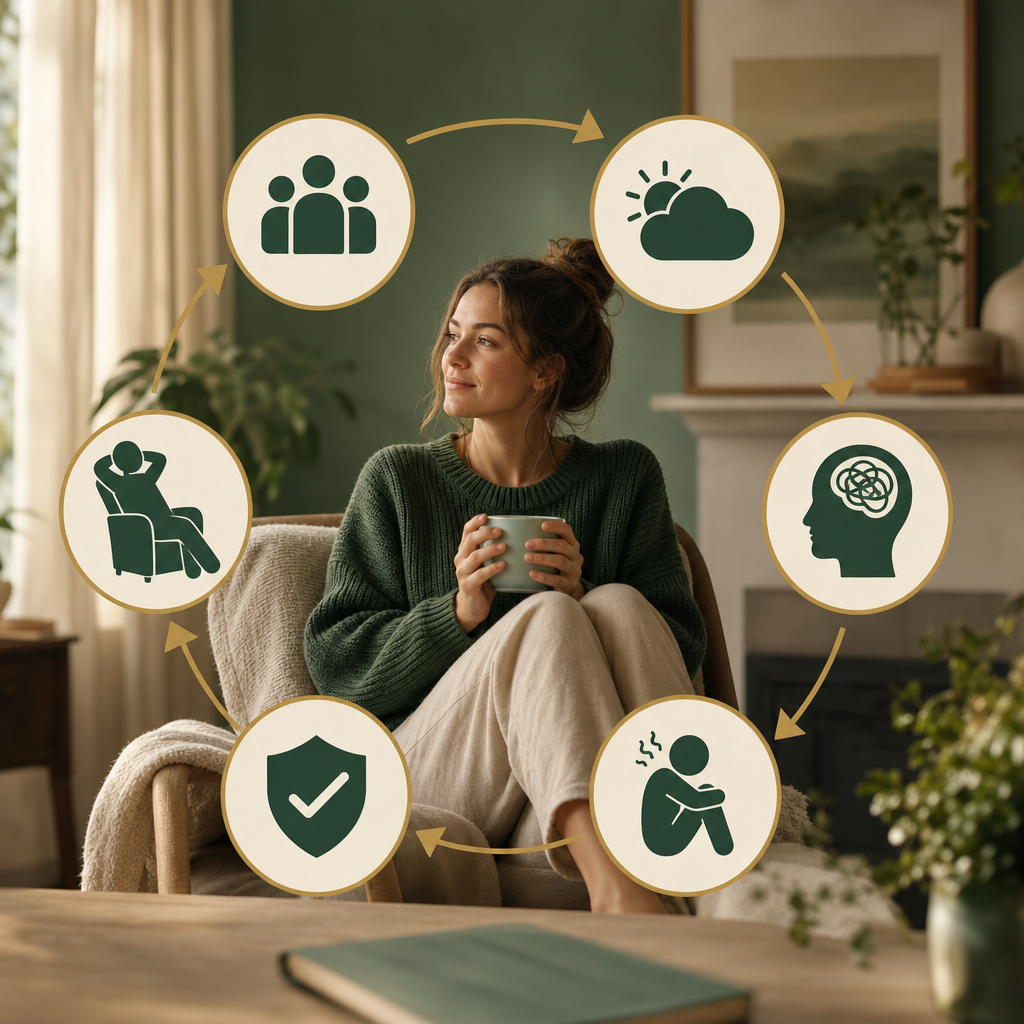
Social anxiety rarely has one simple cause. Temperament, learning, past criticism, bullying, family patterns and stressful social experiences may contribute. What maintains the problem now is often more useful in counselling: threat predictions lead to self-focused attention, safety behaviours and avoidance, which prevent corrective learning.
A person might predict that speaking in a meeting will lead to visible shaking and ridicule. They then script every sentence, avoid looking at colleagues and speak as briefly as possible. If nobody reacts badly, they may conclude that the script protected them. The belief itself remains untested.
This creates a maintenance cycle:
- A social situation triggers a threat prediction.
- Attention shifts inwards to physical sensations and imagined appearance.
- Anxiety increases because every sensation becomes evidence of danger.
- Avoidance or safety behaviours provide immediate relief.
- The person misses evidence that they could cope without those protections.
- Post-event review strengthens the original fear.
Good counselling makes this cycle specific. "I get anxious around people" is too broad for useful planning. "I avoid asking questions in team meetings because I expect people to think I am unprepared" gives the practitioner and client something concrete to examine.
Social anxiety is not a character flaw. It is a learned threat pattern that can become highly rehearsed. Counselling helps create different experiences, but it should not promise that all nervousness will disappear. Some anxiety is a normal response to uncertainty and evaluation.
How does social anxiety counselling work?

Social anxiety counselling combines understanding with structured behavioural change. Sessions should identify feared outcomes, avoidance and safety behaviours, then develop manageable ways to test those fears. Cognitive behavioural therapy is a leading treatment approach, while acceptance, mindfulness and interpersonal methods may support needs that extend beyond anxiety symptoms.
The National Institute for Health and Care Excellence recommends individual cognitive behavioural therapy developed specifically for social anxiety disorder for adults seeking psychological treatment. This is more precise than offering generic reassurance or discussing the week without a clear formulation.
Cognitive behavioural therapy
Cognitive behavioural therapy, commonly called CBT, examines the relationship between situations, thoughts, attention, physical reactions and behaviour. It does not rely on replacing every negative thought with a positive one. Instead, it asks whether a prediction is accurate, useful and testable.
A useful behavioural experiment starts with a clear prediction. Consider someone who believes that asking a basic question during training will make colleagues view them as incompetent. They might ask one genuine question, observe what actually happens, and compare the result with the original prediction.
The learning is not necessarily "everyone approved of me". A more durable conclusion might be "I can tolerate uncertainty about what others think, and asking a question did not produce the rejection I expected".
Gradual exposure
Exposure means approaching feared situations in a planned way rather than waiting to feel completely confident. It should be collaborative, relevant and sufficiently challenging to create learning. It is not about forcing someone into their worst fear without preparation.
A practice sequence might move from making brief eye contact, to asking a shop assistant a question, to contributing in a small meeting. The exact order depends on the person. Difficulty alone is not the goal. Each task should test a meaningful prediction or reduce reliance on a safety behaviour.
Repeating a task matters because one successful attempt can be dismissed as luck. Practice across different situations helps the learning become more flexible.
Attention and self-consciousness
Many socially anxious people monitor themselves from an imagined observer's viewpoint. They estimate how red their face looks, whether their hands appear awkward or how their voice sounds. This consumes attention that would otherwise be available for listening and responding.
Counselling may use exercises that shift attention towards the other person, the room or the task. This is not distraction from anxiety. It corrects an attention pattern that can distort how the interaction feels.
Acceptance-based methods
Trying to conceal or eliminate every sign of anxiety can become another safety behaviour. Acceptance-based work helps a person notice uncomfortable thoughts and sensations without treating them as instructions.
The practical question changes from "How do I make sure I never feel awkward?" to "What would I choose to do here if awkwardness were allowed to come with me?" This can be particularly useful when the person's life has narrowed around avoiding discomfort.
What happens in the first counselling session?
A first social anxiety counselling session should clarify what happens, where it happens and what you want to change. Expect questions about triggers, physical symptoms, avoidance, relationships, work or study, previous support and current safety. You should also have time to assess whether the practitioner feels suitable.
You do not need to arrive with a polished explanation. No essay required. A starting point can be as simple as, "I avoid speaking in meetings and replay everything afterwards".
A practitioner may explore:
- situations you avoid completely
- situations you endure with intense distress
- strategies you use to prevent embarrassment
- what you predict other people will notice or think
- how anxiety affects work, study, relationships and daily tasks
- previous counselling, diagnoses, medication or medical care
- your goals and preferred pace
- current risks that require different support
You should leave with a clearer picture of the problem and the next step. That step might involve monitoring triggers, building a personalised anxiety cycle or choosing a small behavioural experiment.
The session is also an opportunity to ask direct questions. What experience does the practitioner have with social anxiety? Which methods do they use? How will progress be reviewed? What happens if the approach is not helping?
Fit matters more than anything else in therapy. That does not mean every session must feel comfortable. It means you can speak honestly, understand the rationale and disagree without being dismissed.
Is online counselling suitable for social anxiety?
Online counselling can suit adults who want private, regular support without travelling to a clinic or sitting in a waiting room. It may make the first step easier, but it should not become another form of avoidance. The work still needs to connect with social situations outside the session.
Online sessions can be useful for people seeking appointments in the evenings, without time off. They can also widen practitioner choice when local availability, language needs or clinic wait lists limit suitable options.
A secure video session can support most core counselling tasks, including assessment, cognitive work, planning behavioural experiments and reviewing between-session practice. Exposure tasks may happen between appointments, or sometimes during a session where appropriate. For example, a client might practise making a telephone enquiry and then review the outcome with the practitioner.
The limitation is important. Someone could feel comfortable talking from home while continuing to avoid work, study or social settings. A sound online plan should therefore include real-world practice linked to the person's goals.
Before booking, check:
- where the practitioner is located
- their qualifications and relevant experience
- which languages they offer
- how video sessions and personal information are handled
- what happens if the connection fails
- cancellation and rescheduling terms
- crisis and emergency boundaries
- whether they diagnose or prescribe
Private, secure, yours should describe the session environment, not just the marketing language. You also need a reasonably private room, a stable connection and a device you can use without being overheard.
How to choose a social anxiety counsellor
Choose a practitioner by checking relevant experience, qualifications, professional boundaries, communication style and availability. A directory profile should provide enough information to make an informed decision before paying. Vague claims such as "anxiety expert" are less useful than transparent training, experience and methods.
InnerHub applies a Trust framework when reviewing practitioners and explaining their background. It includes reviewing core qualifications, professional memberships and insurance. Profiles show the degree, institution, country where it was earned, years of experience and languages.
InnerHub also discloses that its practitioners are not AHPRA-registered. They do not diagnose conditions or prescribe medication. This distinction matters. A counsellor can support anxiety-related thoughts, behaviour and coping, while a GP, registered psychologist or psychiatrist may be needed for diagnosis, medication or coordinated clinical care.
Questions worth asking include:
- Have you worked with avoidance, fear of judgement and post-event rumination?
- How do you use exposure or behavioural experiments?
- How will we decide what to practise between sessions?
- How do you adapt the approach if I also have depression, trauma or panic symptoms?
- How do you review whether counselling is helping?
- What are your limits around crisis care and diagnosis?
Be cautious if a practitioner guarantees a cure, dismisses questions about credentials or pushes confrontation without consent. Social anxiety support requires challenge, but challenge should have a clear purpose and agreed pace.
Changing practitioners is not failure. If the relationship feels wrong, the rationale remains unclear or your concerns are repeatedly minimised, look for a better fit.
Access is part of the treatment, not an administrative detail
Social anxiety counselling cannot help if cost, referrals, paperwork or long waits prevent consistent attendance. My position is direct: therapy should be affordable enough to use regularly, not just afford once. Access also needs transparent pricing, real availability and freedom from subscription billing that renews in the background.
The common assumption is that quality therapy must carry a $200 price tag, rely on Medicare arrangements or sit inside a subscription. InnerHub takes a different approach. Online sessions cost one flat price, always: $59.90 AUD per session, all inclusive, based on InnerHub's own service pricing.
That price is possible through technology, a global practitioner network, differences in overseas living costs and no clinic overhead. Lower cost does not remove the need for credential checks, insurance, secure systems or clear boundaries.
In one InnerHub booking experience, a person facing referrals, paperwork and clinic wait lists used the platform to find a practitioner and book directly. Their first session was booked in under 10 minutes, without a referral or subscription. InnerHub's own booking data shows that most people book their first session in under ten minutes.
In another case, a client wanted regular support but needed the full cost before committing. Four sessions cost $239.60 AUD in total at the flat rate of $59.90 AUD per session. There was no gap fee maths and nothing renewing in the background.
InnerHub's How It Works process is deliberately short:
- Tell us what brings you here.
- Get matched with your therapist.
- Meet on secure video, inside InnerHub.
The deeper point is not convenience for its own sake. Social anxiety already creates hesitation, uncertainty and avoidance. A service should not add a maze before the first conversation. The practical standard is talking this week, not next month, with real experience, real availability.
If you are ready to ask about social anxiety counselling, visit InnerHub's /contact page. InnerHub supports adults and does not provide crisis care, diagnosis or prescriptions.
When counselling is not enough
Counselling is not the right sole response when there is immediate danger, a mental health crisis, severe functional decline or a need for medical assessment. A GP can assess symptoms, discuss treatment options and coordinate care. Emergency and crisis services should be used when support cannot safely wait.
Seek broader clinical support if anxiety is accompanied by significant depression, self-harm thoughts, harmful substance use, inability to complete essential daily activities or symptoms that may have a medical cause. Medication questions require a doctor or other authorised prescriber.
If you or someone else is in immediate danger in Australia, call 000. Lifeline provides crisis support on 13 11 14. InnerHub is not a crisis service and is not available to people under 18.
References
These sources provide recognised health information and clinical guidance relevant to social anxiety. They support the distinction between ordinary shyness and clinically significant anxiety, outline common symptoms, and describe recommended psychological treatment. InnerHub prices, booking times and service boundaries cited above come from InnerHub's own business data and operating model.
- Healthdirect Australia, Social anxiety disorder
- National Institute for Health and Care Excellence, Social anxiety disorder: recognition, assessment and treatment
- Better Health Channel, Social phobia
- Lifeline Australia, Crisis support
Keep reading in your inbox
Get our free guide to what therapy actually costs in Australia. Name and email only, unsubscribe any time.
Frequently asked questions
Can counselling help with social anxiety?
Yes. Counselling can help you understand anxious predictions, reduce avoidance, change safety behaviours and practise responding differently in feared situations. Progress usually requires applying the work outside sessions rather than relying on conversation alone.
How long does social anxiety counselling take?
There is no universal timeline. It depends on symptom severity, goals, other mental health concerns, session consistency and between-session practice. Progress should be reviewed through meaningful participation, reduced avoidance and recovery from setbacks.
Can social anxiety counselling happen online?
Yes. Assessment, cognitive work, behavioural planning and progress reviews can happen over secure video. Real-world practice remains important because online counselling should support engagement outside the session.
Do I need a referral or mental health care plan?
You do not need a referral or mental health care plan to book with InnerHub. InnerHub practitioners are not AHPRA-registered, do not diagnose and do not prescribe medication. A GP or appropriately registered clinician may be needed for diagnosis, medication or Medicare-related pathways.
How much does InnerHub social anxiety counselling cost?
InnerHub's own service pricing is $59.90 AUD per online session, all inclusive. There is no subscription, session cap or background renewal. Four sessions cost $239.60 AUD in total.
What if speaking to a counsellor makes me anxious?
Tell the practitioner directly, even if you can only say one sentence. A suitable counsellor will expect anxiety and explain the process without demanding a perfect account. You may prepare a short note, but you do not need to script the conversation.
InnerHub
The InnerHub editorial team, writing plainly about therapy, money and getting support in Australia.