
How the platform works
InnerHub · 2026-08-21 · 19 min read

InnerHub helps adults find an experienced online therapy practitioner, book directly and meet through secure video inside the platform. You answer a few practical questions, review suitable practitioner profiles and choose an available time. Each session costs a flat $59.90, with no referral, subscription, Medicare plan or automatic renewal.
Online therapy should remove barriers, not replace clinic paperwork with a different kind of friction. InnerHub brings practitioner discovery, transparent profiles, scheduling, payment and secure video into one place.
This guide explains each part of the process, what you can check before booking, what a session includes and where InnerHub's professional boundaries sit.
Key takeaways
InnerHub is designed for adults who want regular, accessible online therapy without referrals, subscription billing or unclear gap fees. The platform handles matching, practitioner comparison, booking, payment and secure video. Clients retain control over who they see, when they book and whether they continue.
- Tell InnerHub what brings you to therapy, with no essay required.
- Review practitioner qualifications, country, experience, languages and availability.
- Book most first sessions in under 10 minutes, based on InnerHub's own platform data.
- Pay one flat price of $59.90 per session, all inclusive.
- Meet through secure video inside InnerHub rather than arranging separate software.
- Change practitioners if the fit is wrong, without being locked into a subscription.
Talk to someone this week
Get matched with your therapist and book a session in minutes. $59.90 flat, no referral, no subscription.
Find a therapistSummary table
The process is deliberately short, but each stage serves a distinct purpose. Matching narrows the field, practitioner profiles support an informed choice, booking confirms the session and secure video keeps the appointment within InnerHub. The table summarises what happens and what remains under the client's control.
| Stage | What happens | What you control |
|---|---|---|
| Tell us what brings you here | You provide practical information about the support you want | What you share and which needs you prioritise |
| Get matched | InnerHub presents practitioners relevant to your preferences | Which profiles you review and whom you choose |
| Book and pay | You select an available appointment and pay the flat session fee | Your appointment time and whether you book another session |
| Meet inside InnerHub | You attend the appointment through secure video | Your location, privacy and whether the practitioner is the right fit |
Source for the platform process and pricing: InnerHub's supplied business data and How It Works framework.
What is the InnerHub platform?
InnerHub is an online therapy platform that connects adults with experienced practitioners and manages the practical parts of care in one place. It is more than a practitioner directory because matching, profiles, booking, payment and secure video work together. It is not a crisis service, diagnostic service or prescription service.
A digital platform generally coordinates interactions between different groups. In InnerHub's case, those groups are people seeking support and practitioners offering online sessions.
That coordination matters because access problems rarely happen in isolation. A person may find a practitioner but face a long wait. Another may find an available appointment but lack a referral. Someone else may afford one appointment, only to discover that regular sessions are not sustainable.
InnerHub's role is to reduce those practical barriers while keeping the person's choice intact. It does not assign a practitioner whom you must accept. It presents information and availability so that you can make an informed decision.
The platform brings together:
- A short intake process focused on what you need
- Matching based on relevant preferences
- Practitioner profiles with qualifications and experience
- Direct appointment selection
- Upfront payment
- Secure video sessions inside InnerHub
- The freedom to book again or stop without a subscription
This is online therapy, without the $200 price tag. The lower fee does not come from Medicare rebates or a limited introductory offer. InnerHub keeps costs down through technology, a global practitioner network, differences in overseas living costs and the absence of clinic overhead.
How does the InnerHub platform work step by step?
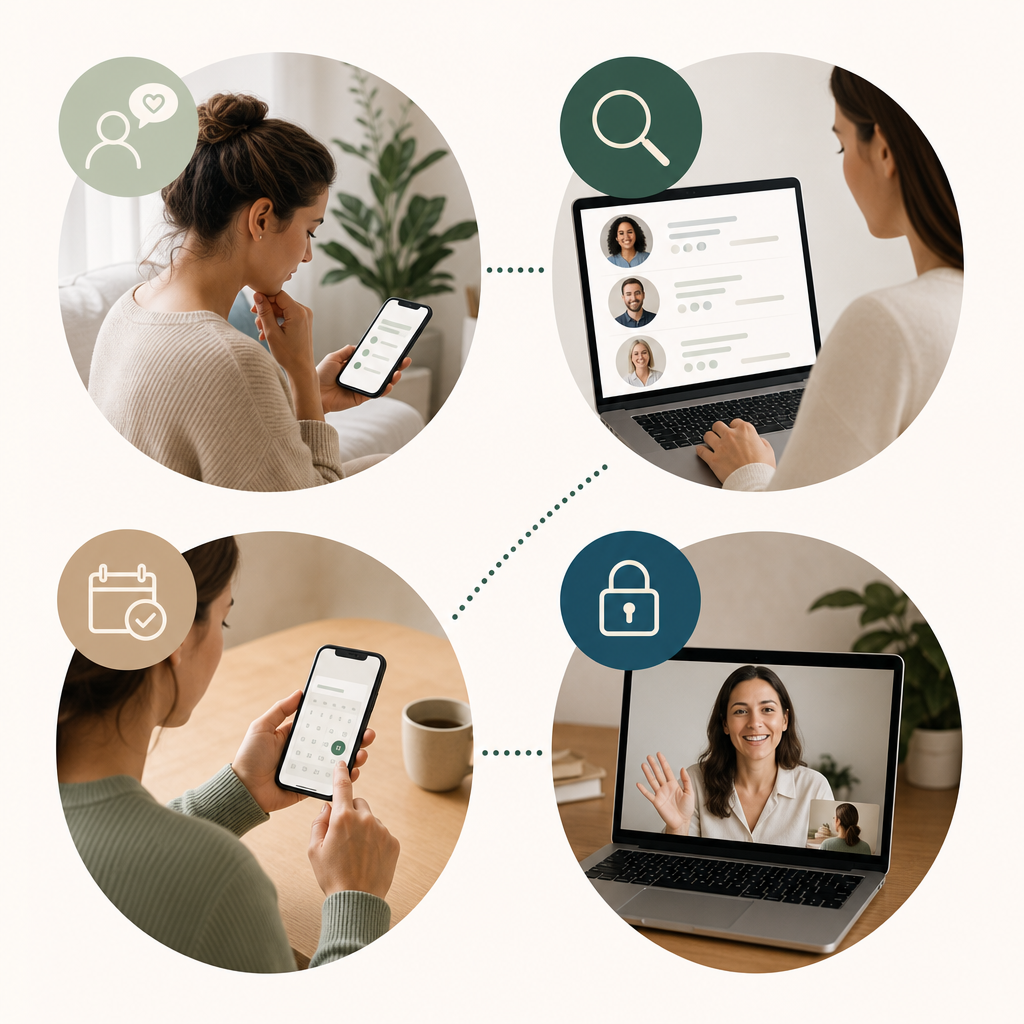
InnerHub uses its How It Works framework: tell us what brings you here, get matched with your therapist, choose an appointment and meet on secure video inside InnerHub. There is no referral, lengthy application or separate video tool. Most people book their first session in under 10 minutes, according to InnerHub's platform data.
Tell us what brings you here
The first step gathers enough information to make the practitioner options relevant. You are not expected to produce a detailed life history before you can see who is available.
You may be looking for help with stress, relationships, grief, work pressure or a difficult period that is hard to define. You might simply be holding it together, barely. The platform needs practical direction, not a polished explanation. No essay required.
This stage should not be confused with a clinical diagnosis. InnerHub practitioners do not diagnose conditions. The purpose is to understand what kind of conversation and practitioner experience may suit you.
Review your matches
Matching reduces the amount of searching, but it does not remove choice. You can examine practitioner profiles before deciding whom to book.
A useful profile should help you answer several questions:
- What qualification does this person hold?
- Which institution awarded it?
- In which country was it earned?
- How many years of relevant experience do they have?
- Which languages do they speak?
- When are they actually available?
- Do their experience and approach fit the reason I am seeking support?
Real experience, real availability matters more than a long list of vague claims. Availability is part of suitability. A highly qualified practitioner who cannot see you when you are free may not be a workable option.
Choose a practitioner and appointment
Once you find a suitable profile, you choose from the practitioner's available appointments. This removes the usual back-and-forth between online enquiries, reception calls and diary checks.
InnerHub's own platform data shows that most people book their first session in under 10 minutes. One person using the platform faced the familiar combination of referrals, paperwork and clinic wait lists. They found a suitable practitioner and completed their first booking in under 10 minutes, without a referral or subscription.
That outcome reflects what the process is built to do: help people start talking this week, not next month, when suitable availability exists.
Pay the disclosed session price
Every session costs $59.90, all inclusive, based on InnerHub's supplied pricing data. The same flat price applies without a subscription, Medicare plan or session cap.
You pay for the session you choose. Nothing renews in the background. There is no monthly allocation to use before it expires and no gap fee maths after a rebate.
This distinction is important. A low advertised monthly price can still be difficult to assess if session credits, plan tiers or cancellation terms determine the real cost. A per-session price makes the commitment clear before you book.
Meet through secure video inside InnerHub
At the appointment time, you meet the practitioner through secure video inside the platform. You do not need to coordinate a separate meeting link or move the therapeutic conversation onto an unrelated consumer video account.
Online delivery can also make practical attendance easier. You can choose a private location and avoid travelling to a clinic. Depending on practitioner availability, evening appointments may allow support without time off work.
The setting still matters. Use a private room where you can speak openly. Wear headphones if other people are nearby. Check your internet connection and device before the appointment. Private, secure, yours does not remove the need to protect privacy at your end.
How does practitioner matching work?
Practitioner matching narrows the available choices using the information you provide, but the final decision stays with you. InnerHub does not treat matching as a claim that one practitioner is objectively perfect. It gives you a relevant starting point, then lets you assess qualifications, experience, languages, availability and personal fit.
Therapy is not a commodity where every qualified provider produces the same experience. Two practitioners may hold relevant degrees yet communicate very differently. One may have deeper experience with the issue you want to discuss. Another may speak a language that allows you to express yourself more naturally.
That is why fit matters more than anything else in therapy. Matching should reduce search friction, not create a new gatekeeper.
What information should guide your choice?
Start with the issue bringing you to therapy. Look for practitioner experience that directly relates to it rather than relying on generic profile language.
Then consider communication and logistics:
- Do you prefer a direct or exploratory conversation?
- Would speaking in another language help?
- Can the practitioner offer appointments you can attend consistently?
- Does the person's professional background make sense for your needs?
- Do you understand where their qualification was earned?
Do not overlook availability. Consistency is difficult when appointments repeatedly clash with work, caring responsibilities or study. The best theoretical match may be less useful than a strong, experienced practitioner whom you can see regularly.
What if the match feels wrong?
You can choose another practitioner. Changing does not mean therapy has failed or that either person has done something wrong.
A practitioner may be competent but not communicate in a way that works for you. You may realise that you need different subject experience. Sometimes the working relationship simply does not feel comfortable enough for an honest conversation.
The platform's job is to make another choice possible. It should not lock you into one practitioner to protect a subscription model or administrative process.
How does InnerHub assess practitioner trust and credentials?

InnerHub uses a Trust framework that reviews core qualifications, professional memberships and insurance before practitioners see clients. Profiles then show the degree, awarding institution, country, experience and languages. InnerHub also states that its practitioners are not AHPRA-registered and do not diagnose conditions or prescribe medication.
Transparency is more useful than a generic claim that every practitioner is verified. Clients need to know what was reviewed, what the credentials mean and what services are outside scope.
Qualifications and professional background
The Trust framework considers:
- Core professional qualifications
- The institution that awarded each degree
- The country where the qualification was earned
- Relevant professional memberships
- Insurance
- Years of experience
- Languages offered
Country matters because professional education and regulatory systems differ. Showing where a degree was earned helps clients understand the practitioner's background rather than assuming every qualification follows the Australian system.
Experience also needs context. A number of years alone cannot guarantee fit, but it provides more information than an unsupported label such as expert. The subject areas described on the profile should also relate to the support you want.
AHPRA registration is disclosed clearly
InnerHub practitioners are not registered with the Australian Health Practitioner Regulation Agency. That boundary should be stated plainly, not hidden in fine print.
AHPRA maintains public registers for professions regulated under Australia's National Registration and Accreditation Scheme. Consumers can use the AHPRA Register of practitioners when they need to verify whether an Australian-regulated practitioner is registered.
InnerHub's global network operates differently. The platform shows the practitioner's actual qualification, institution, country, memberships and experience so clients can assess the basis on which the person practises.
This distinction is especially important if you specifically require an AHPRA-registered psychologist, a formal diagnosis, medication management, a report for another organisation or care under a particular Australian clinical pathway. InnerHub should not be presented as a substitute for those services.
Professional boundaries
InnerHub practitioners do not diagnose mental health conditions or prescribe medication. They provide online therapy within the boundaries disclosed by the platform.
If you need diagnostic assessment, medication advice or coordinated treatment involving an Australian medical practitioner, speak with an appropriately registered healthcare professional. Clear boundaries protect the client because they prevent a general therapy service from implying that it provides regulated services outside its scope.
What happens during an online therapy session?
An InnerHub session is a private video conversation between you and your chosen practitioner. The practitioner will usually begin by understanding what you want from the session, then explore the issue with you at a manageable pace. You do not need a diagnosis, prepared script or perfectly defined goal before attending.
Your first conversation may cover what has been happening, why you chose to seek support now and what you would like to change. You can also ask how the practitioner works and what regular sessions might involve.
Online therapy remains a human conversation. The platform handles the connection and administration, but software does not replace the practitioner's judgement or the working relationship.
How to prepare
A small amount of preparation can make the appointment easier:
- Choose a location where you are unlikely to be interrupted.
- Test your camera, microphone and internet connection.
- Keep water and headphones nearby.
- Think about the main issue you want to raise first.
- Write down questions about the practitioner's approach or boundaries.
- Allow a little time after the session before returning to demanding tasks.
You do not need to prepare a complete account of your life. It is reasonable to begin with what feels most urgent or easiest to explain.
What if technology fails?
Technical problems can happen with any online service. Before booking, review the platform's available support information and relevant appointment terms. At the appointment time, confirm that your browser permissions allow camera and microphone access.
If the connection becomes unstable, avoid moving the conversation to an unapproved channel without understanding the privacy implications. Follow the platform and practitioner's instructions for reconnecting or rescheduling.
How much does InnerHub cost?
InnerHub charges one flat price of $59.90 per session, all inclusive, according to the company's supplied pricing data. There is no subscription, Medicare plan, referral requirement or session cap. You decide when to book and pay for each appointment, which makes the cost of regular support clear in advance.
One flat price, always, is not just a simpler checkout message. It changes whether a person can realistically plan ongoing therapy.
One client wanted regular support but needed the total commitment to be clear. Four sessions cost $239.60 in total, or $59.90 each, based on InnerHub's client account supplied for this article. There was no clinic overhead or subscription charge added to the total.
The point is not that everyone needs the same number of sessions. They do not. The value is cost visibility. You can calculate what your chosen schedule will cost without estimating rebates, plan tiers or unused monthly credits.
Why can the session price be lower?
InnerHub's model combines technology, a global network of experienced practitioners, differences in overseas living costs and no physical clinic overhead. Those structural choices can reduce the fee without depending on short introductory discounts.
Price alone does not establish quality. That is why transparent qualifications, experience, country, languages and professional boundaries are central to the model. Lower cost should come with more information, not less.
Affordability should also be judged over time. A person may be able to stretch to one expensive appointment but be unable to return consistently. Therapy needs to be accessible enough to use consistently, not just afford once.
Is InnerHub private and secure?
InnerHub keeps video sessions inside its platform and presents the experience as private and secure. Clients should still protect privacy at their own location, understand how personal information is handled and use a device they trust. Security is shared between the platform's controls and the practical choices made during each appointment.
Health and therapy information is sensitive. In Australia, the Office of the Australian Information Commissioner explains the privacy obligations that apply to organisations covered by the Privacy Act through the Australian Privacy Principles.
Before using any online therapy service, check its privacy information for clear answers about:
- What personal information is collected
- Why the information is needed
- Where information is handled or stored
- Who may access it
- How access and correction requests work
- What happens if a privacy concern arises
Do not assume that using video from home automatically guarantees privacy. Other people may overhear you, notifications may appear on screen and shared devices may retain account information.
Use a private room, lock the device when unattended and avoid public Wi-Fi where possible. If privacy at home is difficult, consider whether a private office, booked room or another controlled location would be more suitable.
Who is InnerHub suitable for, and who should use another service?
InnerHub is suitable for adults seeking non-crisis online therapy who value direct booking, transparent practitioner profiles and a predictable session price. It is not suitable for people under 18, emergencies, immediate crisis support, diagnosis or medication. Those needs require an appropriate emergency, medical or registered professional service.
You may find InnerHub suitable if you:
- Want to speak with an experienced practitioner online
- Prefer to book without a GP referral
- Need clear pricing before committing
- Want to compare qualifications, country, languages and availability
- Prefer evening availability where offered
- Do not want a subscription
- Want the freedom to change practitioner
InnerHub is not designed for emergency intervention. If you or another person is in immediate danger, contact Australian emergency services. Healthdirect also maintains a current directory of mental health helplines for people who need urgent or specialised support.
You should also choose another pathway if you require:
- Support for someone under 18
- A formal mental health diagnosis
- Prescription medication or medication review
- An AHPRA-registered practitioner
- A report for legal, workplace, insurance or educational purposes
- Crisis assessment or immediate emergency intervention
These are not minor disclaimers. They define what the platform can responsibly provide.
Why accessibility should mean repeatable care, not a cheap first appointment
The usual discussion about affordable therapy focuses too narrowly on the price of one session. My view is different: the useful test is whether someone can understand the full cost, find workable availability and return consistently without navigating referrals, subscriptions or hidden conditions. Access must be repeatable, not promotional.
A discounted first appointment does not solve the problem if later sessions become unclear or unaffordable. Nor does a monthly plan automatically improve access when unused credits expire or a person feels pressured to continue.
InnerHub's model starts with a transparent unit: one session costs $59.90. Four booked sessions cost $239.60. Nothing renews in the background. The person can decide whether another session makes sense based on their needs, experience and budget.
I also reject the idea that price should be used as a shortcut for judging practitioner quality. A high clinic fee may reflect Australian commercial rent, local operating costs and administration. It does not automatically prove better therapeutic fit.
The better assessment combines clear credentials with practical access:
- Is the practitioner's qualification visible and understandable?
- Is their real experience relevant?
- Can you communicate comfortably?
- Are they available when you can attend?
- Can you afford to return if the work needs continuity?
- Can you leave or change practitioner without contractual friction?
That is the platform test many comparisons miss. A service does not become accessible merely because it can be booked online. The whole path, from finding someone to returning for another appointment, must remain workable.
How do you get started?
Getting started means telling InnerHub what brings you to therapy, reviewing your matches and choosing an available appointment. You can complete the process directly without a referral or subscription. Most people book their first session in under 10 minutes, based on InnerHub's own platform data, although individual booking times can vary.
Before booking, decide what matters most to you. That might be practitioner experience, language, appointment timing or a particular area of support. Read the available profiles rather than choosing on availability alone.
When you are ready, visit InnerHub's contact page or begin through the platform. If you are unsure whether the service fits your needs, contact InnerHub before paying. A clear answer about scope is better than booking a service that cannot provide what you require.
References
These sources explain relevant Australian privacy, practitioner registration and crisis-support pathways. InnerHub's process, pricing and booking-time claims are based on the business data and proprietary frameworks supplied for this article. External sources are not presented as endorsements of InnerHub.
- Australian Health Practitioner Regulation Agency, Register of practitioners
- Office of the Australian Information Commissioner, Australian Privacy Principles
- Healthdirect Australia, Mental health helplines
- Australian Government, Triple Zero
Keep reading in your inbox
Get our free guide to what therapy actually costs in Australia. Name and email only, unsubscribe any time.
Frequently asked questions
Do I need a GP referral to use InnerHub?
No. You can use InnerHub and book an online therapy appointment without a GP referral or Medicare plan. You provide practical information about what brings you to therapy, review suitable practitioner profiles and choose an available appointment directly.
How quickly can I book my first session?
Most people book their first session in under 10 minutes, according to InnerHub's own platform data. The timing of the actual appointment depends on current practitioner availability and your scheduling preferences.
Can I choose my therapist?
Yes. Matching provides relevant options, but you decide which practitioner to book. Profiles show qualifications, institution, country, experience, languages and availability. You can choose another practitioner if the initial fit is not right.
Does InnerHub require a subscription?
No. Each session is booked separately for a flat $59.90, all inclusive. There is no subscription, automatic renewal, Medicare plan or session cap. Nothing renews in the background.
Are InnerHub practitioners AHPRA-registered?
No. InnerHub clearly discloses that its practitioners are not AHPRA-registered. The platform reviews core qualifications, professional memberships and insurance, and displays each practitioner's degree, institution, country, experience and languages.
Can InnerHub help during a crisis or prescribe medication?
No. InnerHub is not a crisis service, and its practitioners do not diagnose conditions or prescribe medication. The platform is also not for people under 18. Contact emergency services or an appropriate crisis, medical or registered professional service when those needs apply.
InnerHub
The InnerHub editorial team, writing plainly about therapy, money and getting support in Australia.